Showing posts with label domestic pigs. Show all posts

Saturday, 2 May 2009

Egypt's "cowardly" mass killing of pigs

In Egypt, mass slaughter of the country's 300,000 pigs is slowly beginning. The action was first announced as a security measure "to reduce the risk of a major swine flu outbreak in Egypt". On May 29th, faced with criticism from health experts and the UN's Food and Agriculture Organisation, who pointed out that pigs actually do not carry the swine flu virus, Egyptian officials changed track and said that the cull was more a general health measure than a specific reaction to swine flu. They promised that "cleaner, larger pig farms would be established outside population centres".

The decision has caused an uproar in Egypt.

Egypt's pigs are raised by members of the Coptic Christian minority, garbage collectors in the Cairo slums, who feed them food scraps they collect on their rounds. Culling the pigs would severely threaten their livelihoods. According to the NY Times, "It remains unclear if the government will compensate the farmers for their losses. The Health Ministry originally said the farmers would be paid, but after many in Parliament disagreed, the ministry appeared to back down."
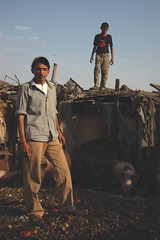
Journalist Per Björklund has written about the situation in his blog.
"Actually, no one I spoke to brought up this issue or portrayed the decision to slaughter the pigs as an attack on christians as a religious group. Instead, one of them offered another theory concerning the motives: 'This is nothing new. Some people have been propagating against the pig farms for a long time. The reason is that there is influential people who want our land, to build expensive apartments. They take this opportunity to get rid of us once and for all.'"

DSC_0007_s, originally uploaded by Per Bjorklund. He has some more photos from the Cairo neighbourhood he visited.


Animal rights activist Brigitte Bardot has written a letter to Egyptian president Hosni Mubarak protesting the decision: “Taking advantage of the global hysteria over the propagation of ’Mexican’ flu, which has nothing to do with animals, in order to launch a campaign to exterminate pigs raised by a destitute section of the population is extremely cowardly."

She also urged the authorities not to proceed with their stated intention to set up what one agriculture ministry official called “new farms in special areas, like in Europe."

Ms Bardot called such facilities “horrific and shameful". “To want to kill all these animals and then later establish intensive piggeries where they will be packed tightly together and badly treated is unacceptable,” she wrote, urging Mr Mubarak to prevent the swine slaugher.

(Source: Times Online)


Let us all take action! Write emails to the Egyptian government protesting this ridiculous decision. Here is the government's website: http://www.egypt.gov.eg/english/guide/directory.aspx - the link goes to Prime Minister Nazif's contact details, and you can also choose different ministries in the drop-down menu to get more email addresses. I haven't been able to find president Mubarak's email address yet, though ...

Here is a simple example of a letter, which you may use as is or modify:

Dear Sirs and Madams,

I am writing to you concerning the Egyptian government's decison to go through with mass killings of pigs. I agree with Ms. Brigitte Bardot, who wrote to President Mubarak recently: The way the Egyptian government is taking advantage of the global hysteria over the propagation of ’Mexican’ flu, which has nothing to do with animals, in order to launch a campaign to exterminate pigs raised by a destitute section of the population, is extremely cowardly.

As for the stated intention to set up “new pig farms in special areas, like in Europe", as a European who knows in what terrible conditions pigs are raised in our factory farms, I must say that such facilities are horrific and shameful. To want to kill all these animals and then later establish intensive piggeries where they will be packed tightly together and badly treated is unacceptable.

Please reconsider and prevent the mass slaugher of the pigs.

Yours sincerely,
[your name and location]

Saturday, 22 November 2008

Pig tooth amulets

Sergei's tooth

I made a necklace out of my pig Sergei's tusk. This is only perhaps half of his tusk - it broke off at one point.

Wild boar tusks have been worn as hunting trophies since ancient times wherever boars have been hunted. They symbolize power and manliness, since boars with their intelligence, strength and willpower are very difficult and dangerous to hunt (even in the age of rifles). In New Guinea, domestic pig teeth are a symbol of men's wealth - the more you have in your necklace, the more important you are. (See what I've written previously about pigs in New Guinea.)

But boar and pig teeth have also been used as magic charms. Those who have read or seen Howard's End will remember that there is primeval symbolism in the form of a wych elm tree, in which the countryfolk have stuck pig's teeth, so that you can chew on the bark to relieve toothache.

Britain and North America: tusks and toothache

In his 1947 book Ozark Superstitions, Vance Randolph gives a study of superstitions among the in his words most superstitious people in the United States. He met a man in McDonald county, Missouri, who kept the blind tooth (the hindmost upper molar) of a pig that he gave his children to wear around their neck whenever they had a toothache. A boar's tusk was believed by others to have the same effect when worn in your pocket; if the toothache was on the right side, you would wear it in your right pocket, and vice versa if it was on the left side. The boar's tooth supposedly also protects against venereal diseases. (The book also accounts of people during the Civil War who believed that seeing a "monstrous black hog" was a death omen, but that belongs in another post ...)

The Journal of American Folklore
Vol. 4, No. 13 (Apr. - Jun., 1891), featured an article on "The Amulet Collection of Professor Belucci". Among the hundreds of items it lists: "36. Aids in dentition of infants, five objects. Pig's tooth, bone."

Straightdope.com ("Fighting Ignorance since 1973") explains how in the origins of the tooth fairy, there are pigs: "
If an animal eats a lost baby tooth, the new teeth coming in will supposedly resemble that animal's such as a dog's tooth or pig's tooth. Letting the tooth be eaten by mice or rats will ensure that the child grows strong, sharp teeth (such folk rituals were recorded as late as 1929)."

South and Central Asia: tusks and the evil eye

Charles Godfrey Leland in 1891 popularized "Gypsy lore" in his book on Gypsy Sorcery and Fortune Telling. "The pig, as is well known, is a common amulet, the origin thereof being that it is extremely prolific", he writes. Boar's teeth "are regarded as protective against malocchio--a general term for evil influences--especially for women during pregnancy, and as securing plenty, i.e., prosperity and increase, be it of worldly goods, honour, or prosperity."

The amulet on the left is from Vienna. (An illustration from Leland's book.)

On the website All About Sikhs, you can read about similar superstitions among Punjabi peasants: "Eating pork or wearing the teeth of a pig round the neck protects a person from the evil eye and witchcraft. [...] Some women make their children wear round their neck nazarbattus (protectors from the evil eye), [to protect from the evil eye], or sometimes for the same purpose hang pig's teeth round their neck."

Turkmen people, despite being Muslims, raise pigs. (V.G. Moshkova in her study The Tribal Gol in Turkmen Carpets, mentions a specific pattern called dunguz burun, 'pig's snout'.)
In Turkmen wedding traditions, "to escape alien eyes the bride wore a cape covering her head along with amulets and charms which were believed to possess guarding forces. All kinds of wedding clothes had a thread from a camel's wool, a pig's tooth, silver plates, beads with "eyes" fastened to them; the cape was furnished with a sawn-on triangular pouch with coal and salt inside (some nations believe that salt has guarding properties)."

These are only two kinds of boar and pig tooth related superstitions, and I'm sure there are more in other cultures of the world. (Voodoo, perhaps?)

Tuesday, 4 December 2007

Pigs in the Pergamon Museum

Today I visited the Pergamon Museum here in Berlin. Of course, I scanned all the exhibits searching for pig motifs, and I indeed found a few.

I apologise for the bad quality of some (most) of the photos. Bad lighting conditions, no flash, handheld camera, crappy white balance, and all that.


Above: Double vessel in the form of two little pigs, Assyria, 8th/7th century BCE. They are likely to be domestic pigs, which makes them quite interesting - pigs didn't seem to be all that common in Assyrian arts and crafts. And is there some particular meaning behind the double shape?


Above and below: Boar's head, Babylon, 1st century BCE/year 12 of Nebukadnezar II. It's hard to tell what exact meaning the boar might have in this case.


Below: This piece was described only collectively as one of a number of "riders and animal figures", but it can hardly be anything but a boar. 2nd-1st century BCE, Babylon. The hairiness of the pig suggests that it's likely to be a wild boar.


Below: An object from Luristan, a province in western Iran inhabited by nomadic tribes. These objects are usually offerings from graves. Somewhere between 8th/7th - mid-3rd century BCE. I'm not sure about its function. The similar piece with a deer above it and the nomadic culture of its makers suggest a hunting theme.


Below: A wall relief plate with a jumping boar, Iraq (Ktesiphon area), 7th-6th century. From the intrados of a house in Umm az-Za'âtir. I'm guessing this piece is related to hunting, as well.


Below: Hunting bowl with a Sassanid great king attacked by a boar, Iran, 7th century. Silver, partly gilded. The wild boar as a dangerous adversary. Of course, the king will be victorious in the end ...


Below: A seal stone (to the left) with a wild boar and Pahlavi inscription, Iran, 5th-6th century. To the right is an enlarged image of its impression. I wish I knew what the incription says.

Friday, 8 June 2007

Pig-to-human xenotransplants

Since many humans are very afraid of death and illness, there is a constant quest to find cures for diseases and malfunctions of the body. When an organ in the human body fails, it can nowadays be replaced with a healthy organ from a donor. Kidneys can be taken from living humans who are okay with getting on with only one kidney, while livers, hearts and other single organs will have to be taken from a dead human.

There is, however, a shortage of donated organs, and patients will often have to wait very long, and pay very large sums of money for it. Organs are big business, and there are sometimes reports of criminals killing people for their organs, or tricking people for a kidney.

Another possibility might be to transplant organs from genetically modified pigs. Pigs are very similar in size and form, and with genetical modification, it could be possible to make them even more similar to the human who would get the organ. Here is a basic Q&A about pig-to-human xenotransplants.

But pig organ transplants are dangerous and costly. Professor Sheila McLean and Doctor Laura Williamson spent 16 months putting together a 700-page document on the legal and ethical implications of xenotransplantation, and to help formulate a strategy for proceeding with the contentious technology.

"Its conclusions, leaked to The Observer at the end of June 2003, warn that the NHS and companies involved would be liable for a huge lawsuit if new, potentially lethal viruses emerge from the practice of putting pig cells and organs into the human body. And if the disease - which some experts have warned could create a new HIV-type virus - spreads across the world, the Government could be sued for breaching international law.

Patients would also have to choose between death and agreeing to lifelong monitoring and not to have unprotected sex or children, in case any disease could be passed on to another generation."

In the end, the government decided not to publish parts of the report, causing wide outrage.
Something else that could only be published after years of legal battle are the Diaries of Despair, a report on "the secret history of pig-to-primate organ transplants", which in horrific detail reveals one of Britain's most extreme programmes of animal experimentation, made to prepare the way for pig-to-human organ transplants.

Finally, Xenotransplantation - How Bad Science and Big Business Put the World at Risk from Viral Pandemics (Mae-Wan Ho and Joe Cummins, ISIS Sustainable Science Audit #2) "exposes the shoddy science that puts the world at risk of viral pandemics for the sake of corporate profit, and concludes that xenotranplantation should not be allowed to continue in any form. Instead, effort should be devoted to developing safer, more sustainable and affordable alternatives that are already showing promise and will be more likely to benefit society as a whole in the industrialized west as well as in the Third World."

Read more in this Stanford article.

---

This whole issue makes me think of Mikhail Bulgakov's Heart of a Dog, where a professor implants human testicles and pituitary gland into a stray dog called Sharik. (The story deeply disapponted me, as I had always thought it would be about a human who gets a dog heart transplant and turns doglike (and becomes a bigshot in the new Soviet Russia). But instead, it's a dog that gets human organs, and slowly turns more and more like the human donor (and becomes a bigshot in the new Soviet Russia). Hmm, so why "heart of a dog "? I only like the story because of the dog's internal monologues, before and after his period as the (mostly) human "Poligraf Poligrafovich Sharikov" ...)

Somewhere, a pig was herding sheep ...

... But I can't find the article about it.

Today I read in the Swedish newspaper DN about the llama stallion Grosse Günther, who will protect a herd of sheep against wolves. "At four years of age, the llamas are equipped with so-called killer-teeth, sharp like razorblades and enough to get most attackers", the sheepfarmer Ulf Ekman explains.

It's a bit funny, because I thought livestock guarding dogs (NB, not the same as herding dogs) were the best choice for protecting sheep against wolves (employed by sheepfarmers wherever humans, wolves and sheep have been coexisting since earliest times). Here is a report on livestock guarding dogs in Slovakia (in PDF format). Some typical livestock guarding dog breeds are Carpathian shepherd dogs, Mioritic shepherd dogs, Caucasian ovcharkas, Central Asian ovcharkas and Kangals.

But maybe these Swedish sheepfarmers don't have any experience with such dogs, and a llama is much easier for them to handle?

Anyway, why is this post about dogs, sheep and llamas, but not pigs?

Well, as I read about Grosse Günther, I remembered a story about a pig herding sheep some time in the 19th century, like a real-life Babe. The pig would lead the sheep to good grazing, bring them home in the evenings, and chase off wolves if need be.
I came across that story a couple of years ago as I was researching for "Pigs Have Wings", but I can't find it anymore ... If anyone has more luck than me, drop me a note!

Sunday, 6 May 2007

Ambient pigs

This is the back cover of the record "Pig" by Stephen Ugo Rosen, "a collection of 9 'dirty' ambient tracks".

"The term 'dirty' is used here because ambient music has a reputation for being 'pure' or lofty in many respects and this collection deliberately attempts to throw the atmospheres down in the mud."


Of course, what is a better symbol for dirtiness than pigs forced to live in such a cramped space that they have no chance of keeping themselves clean?

Placing a naked human among them (with some chains across his shoulders for potential kinkiness/fanservice) puts the plight of pigs raised for meat in a whole new light, because they look so very similar.
Humans get into conditions like this when imprisoned in 'inhumane' conditions in cramped cells with no access to toilets, while such conditions are the norm for most pigs raised for meat. (Sows in factory farms, who spend most of their lives in "gestation crates" - outlawed in the EU and some US states - and give birth and nurse their piglets in "farrowing crates" can't even turn around.)

Dead corpse diesel

BBC News puts it this way: "A solution for the world's energy crisis may come in the form of a pig."

"American oil company ConocoPhillips and Tyson Foods, the world's biggest meat producer, have announced that they will produce diesel from pork fat.
Cows and chickens will also be transformed to power motor vehicles.
The companies say that this renewable source of energy will be cleaner than conventional diesel. It is hoped that it will be available at petrol stations by the end of the year."


The animal diesel will, according to Geoff Webster, who is managing the scheme for Tyson Foods, not come from animals processed solely for diesel, but it will be produced from "waste", i.e. the remains of the animals that are not used for meat products. Animal fat and "other waxy waste" is nowadays usually used as ingredients for soap, cosmetics and pet food.
Webster also argues that this solution is more environment-friendly than biofuel made from specially grown grain: "We feel that it is a huge step forward as opposed to taking grains which are needed for food around the world and turning those in to [sic] fuel."


But when the diesel is produced it will be "pumped into a network and mixed with other kinds of diesel", so it will be impossible to tell whether the diesel you use is made from animal fat or not. So, this will obviously be an issue for vegetarians and some religious groups.

Besides, while biodiesel, and especially this "animal waste diesel" is hailed as being so "environment-friendly", the point is missed that what actually causes more greenhouse gas emissions is not fossil fuels in cars, but cattle rearing. This is clearly stated in a recent report from the UN Food and Agriculture Organization.


While I do agree that any form of "waste" should be reused in some way, it is rather uninformed to hail animal diesel as The Big Solution For The World's Energy Crisis.

I would say it would be wiser to make efforts to reduce our squanderous energy consumption, by making the things we use more efficient, but also by abstaining from many things that are not really necessary (city jeeps, anyone?). And while a lot of focus is put on the indivudual consumer when it comes to "living more environment-friendly", one should not forget that it's the big industries that cause the most environmental damage. Not least the meat, egg and milk industry with its factory farms.

But, regarding the use of animal waste for diesel - why not waste from humans? For instance, the plastic surgery industry certainly must produce a fair lot of human waste. And what about all the dead human corpses overcrowding our cemeteries, using up excessive amounts of energy being burned to ashes? Wouldn't it be better to turn grandpa into biodiesel, instead?

Wednesday, 11 April 2007

Sugar Mountain Farm - raising pigs naturally on pasture

After the previous posts, here is something more positive. Walter Jeffries on Sugar Mountain Farm, Vermont, explains in a very down to earth way why pasturing pigs is actually much more economical and less work-intensive when you keep them for meat.

"Pasturing the pigs is the easiest, cheapest, least smelly way to do it. And I think the pigs are a lot healthier and happier for it."

In two other posts, he gives his view on castration:

"I do not like castrating piglets. Neither does my wife or son like helping. It is not a pleasant task. It is even less pleasant for the piglets. There is a fair bit of research that suggests that castration is not necessary for boars that are slaughtered before age six months. I have written about this before including links to the research articles. Unfortunately it is traditional and customers want it."

In one of the posts he expresses concern that animal rights movements like PETA ("fanatical anti-farming groups", in his words) will "use" what he says. I'm not fanatically anti-farming, but I think that if you eat pigs, you should at least treat them well.

The rest of the Sugar Mountain Farm blog is also very interesting reading.

Pet pig factories part II

I wrote an E-mail to the breeder mentioned in the entry below and asked a couple of composed and friendly questions. She only answered to one of the questions:

> My pig didn't
> have his teeth clipped, and I don't know of any other pet pigs in my
> area that have had it done. Why do you do it?
((( BECAUSE POTBELLYS PICK ONE TIT & THAT IS THEIRS FOREVER = IF ANOTHER
PIGGLET TRIES TO GET ON IT & NURSE THEY BITE THE MOMS TIT & SOMETIMES SHE
QUITS FEEDING THEM BECAUSE IT HURTS & ANOTHER REASON IS WHEN THEY ARE
PLAYING WITH EACH OTHER THEY CAN CUT THE EARS OF THEIR SISTER OR BROTHER
PIGGLET . SO IT IS A SAFTY FACTOR & YOU DO IT THE MINUTE THEY ARE BORN & IT
DOESN'T BOTHER THEM ..)))

(That's the whole E-mail.) "It doesn't bother them" ... Right. And how come pigs have survived and bred in the wild for thousands of years and been safe and just fine with their teeth intact ...?
Also, if you feel your arguments aren't enough, maybe caps lock will help the message get through.

The breeder's name is Vickie Barrow, and the business is "Best Little Potbelly Pig House in Texas". I also found this interesting entry in a discussion forum.

Since pigs raised for the meat industry are normally so abused, it would seem difficult to make any case against her and other breeders like her. All I as a normal person can do is say: Do not get involved with people like her.

But actually, at least in European legislation clipping of teeth is strongly discouraged, as described in this publication by the Irish Agriculture and Food Development Authority:

"In 1997 the EU Scientific Veterinary Committee recommended grinding or leaving the teeth intact rather than clipping. This report formed the basis for Commission Directive 2001/93/EC, which was adopted into law in November 2001. In earlier drafts of this legislation teeth clipping was banned but the Directive now allows both clipping and grinding in limited circumstances. The procedures can only be carried out where “there is evidence that injuries to sows’ teats or to other pigs’ ears or tails have occurred”. In addition “before carrying out these procedures, other measures shall be taken to prevent tail-biting and other vices”. Hence, all forms of tooth resection are strongly discouraged and in the future teeth clipping may be banned."

Tuesday, 10 April 2007

Pet pig factories and sanctuaries for the abandoned and abused

On this blog, I'm experimenting a bit with whether it might actually be possible to earn anything with Google AdSense. But with pigs as a theme, it's a constant battle to filter out ads for businesses that I consider abusive. That includes most websites related to the meat industry and hunting tourism, but today I also seem to have been advertising for an irresponsible pet potbellied pig breeder/factory.

Their ad says, "extra tiny - beautiful colours - ship worldwide", and on the website to which it points there are pictures of tiny piglets and below them links that say "add to cart" (with the note "pigs in picture are not the pigs you will receive - just examples").
The pictures on the site, with just one exception, though I'm not quite sure about that one either, all show pictures of tiny piglets, not full-grown pigs - although it's with the full-grown ones you will spend the most of your life.

Under "Satisfied customers around the world", it says, "I have shipped piggers all over the U.S. including HAWAII and all over the world to JAPAN, EUROPE & Alaska." What kind of person gets a pet transported such a long way, instead of getting a friend closer to home? Won't the pig be traumatized by the long transport?
And: "4 other Japanese men flew over here just to see my piggers! I took them to other breeders' farms to see other potbelly pigs, but they didn't want theirs - they wanted mine because of the small size & pug noses. I know they will be taken care of, they bought two of them from me two years ago & still have them, but wanted more of my little darlings." - Wow, they actually still have the pigs they bought from you two years ago? Is that enough to say they will be taken care of? Talk about low standards.

The breeder does seem to have some sort of resposibility, as she has an "emergency helpline", a phone number you can call 24/7 if you have 'problems' with your pig. She also guarantees that if "for any reason you need to get rid of your pigger, even years from when you bought it I will take it back, and if there is something wrong with it (health wise, genetically) I will give your money back."

But overall, the piglets she breeds are spoken of as goods or toys to buy and play with, because "they are so funny, entertaining & sweet". Not a word about how sensitive pigs are, how much responsibility it takes to keep a pig (or any other animal), how tricky they can be to train and live with, as they are more intelligent than dogs and can easily start manipulating humans (and so can dogs, but pigs can outsmart stupid and inconsequent humans even easier), or wrecking your house and garden out of boredom or frustration.

And another VERY alarming thing is that she states: "I clip their teeth [...] at 1 day old." WHY????
Clipping teeth is a common practise in factory farming, because it "reduces injuries" from fighting and tail-biting (which is a result of the enormous psychological stress of living in terribly cramped, noisy and dirty conditions in factory farms). Here is a report from the Faculty of Land and Food Systems at the University of British Columbia that has come to the conclusion that even in factory farms, tooth clipping is not really necessary. And here is a BBC article about a farm with free-ranging pigs, where the pigs don't need to have their teeth clipped. Why on earth would pet pigs need to have their teeth clipped?!

I probably couldn't ever breed any animals commercially, because for one thing I think it's unethical, with so many pets abandoned on the streets or in shelters all over the world by irresponsible 'owners', and for another I would live in constant horror about the possibility that the new owners of my little babies would treat them wrong.

If you do know that you can handle a pig and take full responsibility for it, are able to care for it, love it and be consequent and fair to it, you should consider adopting it from a shelter or sanctuary. You should definitely NOT buy it from breeders like this, who treat pigs like toys or objects!

Here is a list of a few sanctuaries and shelters for pigs (not all of them have pigs for adoption, but they treat the pigs they care for with respect and as individuals, something everyone can learn something from):

USA
Pigs, a sanctuary
Ironwood Pig Sanctuary
Pigs Peace Sanctuary
Shepherd's Green Sanctuary
Pig Pals Sanctuary
Belly Draggers Ranch

Canada
Hearts on Noses

UK
Farm Animal Rescue

Germany
Schweineparadies
Schweinefreunde/Minischwein-Vermittlung
Schutzengel für Tiere

These are just a few. Sadly, there are many more, as all too many people abandon their 'pets' after getting them without realising what it means to care for a pig.

Pig baskets

I was randomly googling "pig biscuits" trying to make myself feel good looking at pig-shaped cookies (I seem to have gotten a slight flu). But the subject of pigs is, as always, ambiguous ...

I came across the blog of Singaporean dimsumdolly. She writes at one point about sweet mid-autumn delights, such as mooncakes. Leftover dough from mooncakes is used to make another kind of pastry:

"In order not to waste the dough, the bakeries make it into shapes of mini piglets and place them in these baskets. It was said that in the olden days in China, these "Zhu Long" (猪笼 pig baskets) made of bamboo were used to drown adulterous couples. The villagers would place the adulterous pair in a basket each and throw them into the sea."

A harsh tradition from harsh times, but these "pig baskets" are in fact a horrible way of transporting live pigs that seems to be pretty common in East Asia even today, though nowadays the baskets are not always made of bamboo. If you can handle it, here is a picture of the practise, and here another one (in Vietnam). The pigs are indeed alive - when they are dead no baskets are used. (Read more about livestock transport in Asia and the Pacific in Guidelines for Humane Handling, Transport and Slaughter of Livestock by the Asia/Pacific regional office of the UN Food and Agriculture Organization.)

Of course, it should go without saying that the transport of pigs in the meat industry of other parts of the world is usually not much more humane.

Monday, 9 April 2007

Breastfeeding pigs

Tori Amos (left) has appeared breastfeeding a piglet on the album sleeve of her record Boys for Pele (about which she talks a bit in this interview), alienating hundreds of "fans" (not true fans, I guess) and apparently shocking the hell out of bigot America.

Breastfeeding pigs is in fact something fairly normal among certain tribes in New Guinea.

But there, it's not really anything more eyebrow-raising than "a low-tech version of U.S. sheep ranchers bottle-feeding orphaned lambs", as Answers.com's article on pigs puts it. Taking care of the pigs, the only domesticated animals they have, is one of the main tasks of traditional New Guinean women.

The traditional society in this area doesn't have that much equality between the sexes. In Women Speak Out! A Report of the Pacific Women's Conference (1976) - from where also the black and white photograph below right is taken, it is written in the section about common legal problems for women in Papua New Guinea:

"[Wives] were expected to work long hours in the gardens, then walk home carrying huge loads of firewood and food, then go to the river for water, then cook dinner - and through it all, tend the children. While they did all this work, the men occassionally hunted or fished - or mostly sat under the trees and 'protected' the women from enemy attacks."

As for pigs,

"Women did all the work of caring for pigs - even breast-feeding sick piglets - but their husbands owned them and decided when they would be traded, killed for a feast or given to someone else."

A normal day for traditional New Guinean women might look like Neil Nightingale describes it:

"Each day they take the animals to the gardens and tether them close by. If they are constructing new sweet potato mounds the women allow the pigs to root around in the ground they are about to prepare. In this way the pigs get to feed off any remaining sweet potato tubers while helping the women by churning the soil. In the evening the pigs accompany the women back to their homes. Some spend the night in specially built sties; others sleep in the same huts as the women and their children. While food is prepared for the evening meal the animals are thrown scraps and even whole sweet potato tubers."

Women and pigs have a fairly close relationship:

"The pigs often have names and are treated as part of the family, being stroked, fondled, and gently spoken to as the children prepare for bed.
By tickling their udders and imitating the action of a suckling piglet females can be encouraged to lie down quietly on their side to be gently de-ticked."

In the last sentence it becomes obvious that Nightingale doesn't know very much about pigs, as he explains the pigs' lying down on their side when they get their tummies rubbed as some kind of mechanical reaction to the feeling you get from suckling piglets. Mind you, also a barrow or boar will lie down on his side when he gets his tummy rubbed, simply because it feels good.

The New Guinean pigs, though seemingly treated like pets in our culture, will eventually be killed, but, again, not like regular food animals in Western culture.

As Joyce Kilmer writes,

"Pigs are the only domesticated animals and their value in this culture is a difficult concept to grasp. Although nurtured by women, they are the most important measurement of a man's solvency."

Pigs have great economical, political and mystical importance. They are used to buy brides, sacrificed to appease ancestral spirits and to pay compensation for killing members of another tribe (Nightingale describes how he witnessed about twenty pigs and the equivalent of a thousand UK pounds in cash being handed over as part payment of a large debt for the killing of one man), and in many other important ceremonies. In some parts, "huge pig-giving festivals" are held once every few years, in order to "impress neighbours".

Under Milk Wood

"The sunny slow lulling afternoon yawns and moons through the dozy town. The sea lolls, laps and idles in, with fishes sleeping in its lap. The meadows still as Sunday, the shut-eye tasselled bulls, the goat-and-daisy dingles, nap happy and lazy. The dumb duck-ponds snooze. Clouds sag and pillow on Llaregyb Hill. Pigs grunt in a wet wallow-bath, and smile as they snort and dream. They dream of the acorned swill of the world, the rooting for pig-fruit, the bagpipe dugs of the mother sow, the squeal and snuffle of yesses of the women pigs in rut. They mud-bask and snout in the pig-loving sun; their tails curl; they rollick and slobber and snore to deep, smug, after-swill sleep. Donkeys angelically drowse on Donkey Down."

Dylan Thomas: Under Milk Wood - A Play for Voices

Read the whole text at Project Gutenberg, or, even better, buy the book or borrow it from your local library.
I read it in high school, and it made a deep impression on me, as did a collection of short stories by Dylan Thomas as I read them during my early university years. I had forgotten about this part with the pigs, though, until I came across a quote from it on PiggyPoop.com. (Yes, it's exactly what you think - natural fertilizer made from piggy excrements. But the recipe on their site for "Piggy Poop Tea" is NOT what you think.)

Monday, 26 March 2007

Ben and Orlando

The photographer Traer Scott has in his series Sentients portrayed humans and animals and the often deep emotional and psychological bond they share.

This picture is of Ben and Orlando:


Scott writes: "Orlando fell off a truck bound for the slaughterhouse when he was just a mere 200lb pig. He was taken to animal control and was going to be killed. A Massachusetts family rescued him and made a home for him on their farm. Orlando now weighs over 500lbs. The family's son Ben became very close with Orlando, sometimes when he was younger, the two would sleep together at night."

Visit his website for many more interesting photographs.

Wednesday, 21 March 2007

The People vs. the Pig

One of the great wonders of the Internet is that you can find archived material from many parts of the world dating many years back. Something interesting I came across today is a transcript of the TV program "The Animal Attraction", aired on ABC TV in Australia on February 24, 2001.

Its fourth program - Animals on trial: The People vs. the Pig "takes us over to the dark side. Our relationships with other animals are not all sweetness and light. And over the centuries, we've come up with some truly bizarre attempts to justify our actions." This episode explores "the ethical complexity of our dependence on animals. We find out why animals were put on trial in the middle ages, what witchcraft had to do with pet ownership, and how pet keeping transformed our society."

The program gives an overview of the problematic relation between humans and animals in history, and how humans have dealed with the moral problem in relying on domesticated animals for their survival.

Jonica Newby: Our empathy problem magnified a thousand fold when we were joined by domestic animals and our entire economy became based on exploiting them.

James Serpell: We have to maintain a degree of separation, emotional separation, if you like, from these animals. We have to avoid getting too close, literally, too intimate, too involved, too knowledgable about the nature of that animal and its psychology and its feelings.


[...]

Jonica Newby: Humans face a dilemma that's not been faced by any other animal in the history of our world. Many animals are carnivores. But we're the only ones with the brainpower to sympathise with our victims. And to cope with being a sentient carnivore, we’ve resorted to all sorts of strategies. Where possible, we avoid responsibility for killing. Even abattoir workers subconsciously shift the blame.

[...]

James Serpell: We have this association in our minds of pigs being filthy creatures but, of course, how could they not really be filthy in the kinds of conditions we keep them in. So, there’s a great deal of misrepresentation going on there which, I think, just makes people feel better about the notion that pigs can be killed, you know, because pigs aren’t really worthy of moral concern.

Read the full transcript.

Tuesday, 20 March 2007

Festival of Lard Lovers - Lutsk, Ukraine

Every fall, the town Lutsk celebrates their pork production, in a "daring attempt at global branding" - "to once and for all convince everyone that lard is not food - it's the pride of the nation; to prove that lard is an excellent medical and prophylactic remedy; that Ukrainian traditions and customs are an excellent base for any modern cultural arrangement, and also a self-advertising for the nation as a valid member of the international community".
The slogan of the festival is "Lard-lovers of the world, unite!"

Last year, among the attractions of the festival was a beauty contest. Two dozens of pigs were dressed up like film stars: "The ladies were exceptionally beautiful - in little lace knickers, satin skirts, fishnet stockings, the little snouts lightly accentuated with lipstick. The cavaliers stern and elegant - in hats and vests."

The winner of the contest was the lovely sow Yulya (apparently named in honour of "the princess of the orange revolution" Yulya Timoshenko):


IotD has some more pictures.

Well, it's rather morbid, as even these most beautiful pigs will be slaughtered and eaten in the end ... It's like Two Thousand Maniacs, where some yankee tourists are lured into a small town in the deep South for a certain centennial celebration ... Aww, widdle piggy, you're so nice and cute and funny ... okay, let's kill you!

Pigs in Paradise

David Pacchioli writes about the quest of a few brave men to find the mysterious "pig half-man half woman" in the Republic of Vanuatu. In their quest they not only find themselves, but also delve into the mystery of intersexuality and maleness.

In Vanuatu, "pigs are a measure of wealth throughout most of the islands and are a part of many ceremonies. The most prized pig is the male with curled tusks. The upper canines are removed allowing the tusk to grow into a curl, a process taking up to 14 years. Pigs are used to pay for grade taking rights, penalty payment for breaking tabu, for trade and as gifts for marriage, death, circumcisions, initiations, etc. Ultimately the pigs are ritually killed by high ranking men and the curled tusk is worn by these men as a status symbol."


"Looking after your pig." From vanua.com