Saturday, 2 May 2009

Egypt's "cowardly" mass killing of pigs

In Egypt, mass slaughter of the country's 300,000 pigs is slowly beginning. The action was first announced as a security measure "to reduce the risk of a major swine flu outbreak in Egypt". On May 29th, faced with criticism from health experts and the UN's Food and Agriculture Organisation, who pointed out that pigs actually do not carry the swine flu virus, Egyptian officials changed track and said that the cull was more a general health measure than a specific reaction to swine flu. They promised that "cleaner, larger pig farms would be established outside population centres".

The decision has caused an uproar in Egypt.

Egypt's pigs are raised by members of the Coptic Christian minority, garbage collectors in the Cairo slums, who feed them food scraps they collect on their rounds. Culling the pigs would severely threaten their livelihoods. According to the NY Times, "It remains unclear if the government will compensate the farmers for their losses. The Health Ministry originally said the farmers would be paid, but after many in Parliament disagreed, the ministry appeared to back down."
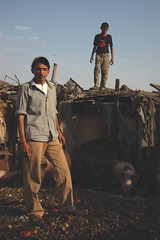
Journalist Per Björklund has written about the situation in his blog.
"Actually, no one I spoke to brought up this issue or portrayed the decision to slaughter the pigs as an attack on christians as a religious group. Instead, one of them offered another theory concerning the motives: 'This is nothing new. Some people have been propagating against the pig farms for a long time. The reason is that there is influential people who want our land, to build expensive apartments. They take this opportunity to get rid of us once and for all.'"

DSC_0007_s, originally uploaded by Per Bjorklund. He has some more photos from the Cairo neighbourhood he visited.


Animal rights activist Brigitte Bardot has written a letter to Egyptian president Hosni Mubarak protesting the decision: “Taking advantage of the global hysteria over the propagation of ’Mexican’ flu, which has nothing to do with animals, in order to launch a campaign to exterminate pigs raised by a destitute section of the population is extremely cowardly."

She also urged the authorities not to proceed with their stated intention to set up what one agriculture ministry official called “new farms in special areas, like in Europe."

Ms Bardot called such facilities “horrific and shameful". “To want to kill all these animals and then later establish intensive piggeries where they will be packed tightly together and badly treated is unacceptable,” she wrote, urging Mr Mubarak to prevent the swine slaugher.

(Source: Times Online)


Let us all take action! Write emails to the Egyptian government protesting this ridiculous decision. Here is the government's website: http://www.egypt.gov.eg/english/guide/directory.aspx - the link goes to Prime Minister Nazif's contact details, and you can also choose different ministries in the drop-down menu to get more email addresses. I haven't been able to find president Mubarak's email address yet, though ...

Here is a simple example of a letter, which you may use as is or modify:

Dear Sirs and Madams,

I am writing to you concerning the Egyptian government's decison to go through with mass killings of pigs. I agree with Ms. Brigitte Bardot, who wrote to President Mubarak recently: The way the Egyptian government is taking advantage of the global hysteria over the propagation of ’Mexican’ flu, which has nothing to do with animals, in order to launch a campaign to exterminate pigs raised by a destitute section of the population, is extremely cowardly.

As for the stated intention to set up “new pig farms in special areas, like in Europe", as a European who knows in what terrible conditions pigs are raised in our factory farms, I must say that such facilities are horrific and shameful. To want to kill all these animals and then later establish intensive piggeries where they will be packed tightly together and badly treated is unacceptable.

Please reconsider and prevent the mass slaugher of the pigs.

Yours sincerely,
[your name and location]

Tuesday, 24 March 2009

Cвинокулебяки

Кулебяка is a traditional Russian dish: a big pirogue with some sort of filling. For the filling you can pretty much use anything (salty) you like: mushrooms, boiled eggs, spinach, cheese, rice, potatoes, cabbage, fish or whatever.

It's almost surprising how often it is made in the shape of a piggy.


A "svinokulebyaka" by meladan, posted in the LiveJournal community ru_piggy.


A sliced piggy-kulebyaka accompanies a recipe on the Russian recipe site kuking.net ...


This lovely kulebyaka was made by LarkinaL and posted on the photo community foto@mail.ru.

For an English-language recipe, check out Moti's Iraqi cuisine (he has a hammer and sickle variation).

Other popular non-abstract shapes include fish and crocodiles.

Sunday, 14 December 2008

Pigs as symbols of capitalism

Piggy-banks are an obvious tool for accumulating capital, and thus a symbol for capitalism.

Read more about piggy banks! In the Anglo-Saxon cultural sphere, the pig shape is often dismissed as an etymological mistake between "pig" and "pygg" - a type of clay that was often used to make jars where money was stored. But as we have previously seen, pigs have been regarded as a symbol for prosperity since ancient times, so I don't entirely want to believe that explanation ...

Anyway, this video by Belarussian rock band Lyapis Trubetskoi has a lot of piggy-bank imagery.


Lyapis Trubetskoy «Capital» from Alexey Terexov on Vimeo.

The animation, by Alexei Terekhov at Cosmosfilm.tv, depicts various politicians who are officially anti-imperialist and opposing globalization, but who in fact are more or less hypocrites motivated by personal lust for power and wealth.

Wednesday, 26 November 2008

Turn capitalism into fighting its ailments! With piggies!

CharityUSA.com has a number of sites that raise funds to fight against hunger, breast cancer and animal abuse, and for child health and rainforest conservation.

The fundraising is done on one hand by the "one click per day" principle - if you click a certain link, you will be taken to a page with ads by sponsors who fund for example mammograms. On the other hand they sell all kinds of merchandise, and part of the revenue goes to fund for example food aid.

Capitalism can be viewed as a culprit in some of the ailments these projects are alleviating - in a socialist state, for example, healthcare and literacy would be funded by the state, highly prioritized and freely available to all citizens, while in a market economy you can much more easily fall out of the system and not get any healthcare and education if you don't have the money to pay for it (yours truly lives in a market economy and cannot afford healthcare at the moment).

Still, I guess this is a pretty clever way to use capitalist tools (advertising, consumption) for the common good.

If you buy a hand made clay piggy from Chile (where they say three-legged clay pigs bring luck!) or one of these likewise hand made piggy potholders from Thailand (made by a cooperative of retired art techers), each of the piggies purchased will fund 25 cups of food for people in need.

You can even fund a non-profit microloan for a pig in Guatemala.

Saturday, 22 November 2008

Pig tooth amulets

Sergei's tooth

I made a necklace out of my pig Sergei's tusk. This is only perhaps half of his tusk - it broke off at one point.

Wild boar tusks have been worn as hunting trophies since ancient times wherever boars have been hunted. They symbolize power and manliness, since boars with their intelligence, strength and willpower are very difficult and dangerous to hunt (even in the age of rifles). In New Guinea, domestic pig teeth are a symbol of men's wealth - the more you have in your necklace, the more important you are. (See what I've written previously about pigs in New Guinea.)

But boar and pig teeth have also been used as magic charms. Those who have read or seen Howard's End will remember that there is primeval symbolism in the form of a wych elm tree, in which the countryfolk have stuck pig's teeth, so that you can chew on the bark to relieve toothache.

Britain and North America: tusks and toothache

In his 1947 book Ozark Superstitions, Vance Randolph gives a study of superstitions among the in his words most superstitious people in the United States. He met a man in McDonald county, Missouri, who kept the blind tooth (the hindmost upper molar) of a pig that he gave his children to wear around their neck whenever they had a toothache. A boar's tusk was believed by others to have the same effect when worn in your pocket; if the toothache was on the right side, you would wear it in your right pocket, and vice versa if it was on the left side. The boar's tooth supposedly also protects against venereal diseases. (The book also accounts of people during the Civil War who believed that seeing a "monstrous black hog" was a death omen, but that belongs in another post ...)

The Journal of American Folklore
Vol. 4, No. 13 (Apr. - Jun., 1891), featured an article on "The Amulet Collection of Professor Belucci". Among the hundreds of items it lists: "36. Aids in dentition of infants, five objects. Pig's tooth, bone."

Straightdope.com ("Fighting Ignorance since 1973") explains how in the origins of the tooth fairy, there are pigs: "
If an animal eats a lost baby tooth, the new teeth coming in will supposedly resemble that animal's such as a dog's tooth or pig's tooth. Letting the tooth be eaten by mice or rats will ensure that the child grows strong, sharp teeth (such folk rituals were recorded as late as 1929)."

South and Central Asia: tusks and the evil eye

Charles Godfrey Leland in 1891 popularized "Gypsy lore" in his book on Gypsy Sorcery and Fortune Telling. "The pig, as is well known, is a common amulet, the origin thereof being that it is extremely prolific", he writes. Boar's teeth "are regarded as protective against malocchio--a general term for evil influences--especially for women during pregnancy, and as securing plenty, i.e., prosperity and increase, be it of worldly goods, honour, or prosperity."

The amulet on the left is from Vienna. (An illustration from Leland's book.)

On the website All About Sikhs, you can read about similar superstitions among Punjabi peasants: "Eating pork or wearing the teeth of a pig round the neck protects a person from the evil eye and witchcraft. [...] Some women make their children wear round their neck nazarbattus (protectors from the evil eye), [to protect from the evil eye], or sometimes for the same purpose hang pig's teeth round their neck."

Turkmen people, despite being Muslims, raise pigs. (V.G. Moshkova in her study The Tribal Gol in Turkmen Carpets, mentions a specific pattern called dunguz burun, 'pig's snout'.)
In Turkmen wedding traditions, "to escape alien eyes the bride wore a cape covering her head along with amulets and charms which were believed to possess guarding forces. All kinds of wedding clothes had a thread from a camel's wool, a pig's tooth, silver plates, beads with "eyes" fastened to them; the cape was furnished with a sawn-on triangular pouch with coal and salt inside (some nations believe that salt has guarding properties)."

These are only two kinds of boar and pig tooth related superstitions, and I'm sure there are more in other cultures of the world. (Voodoo, perhaps?)

Thursday, 2 October 2008

Current call for action: Rosi!


Rosi is a dazzlingly beautiful 9 year old potbellied pig lady. She was abandoned at the Hoffnung für Tiere ("Hope for animals") shelter near Dresden, Germany, when her humans divorced. Apparently there was no place for their faithful companion of nine years in their lives anymore.
Due to Rosi's age and the fact that she has developed a breast tumour, the shelter doesn't believe she will find a new home anytime soon, if ever. But you can become her "godfather"/"godmother" and sponsor her so she will be able to live the last years of her life happily and comfortably at the shelter.
Here is the shelter's potbellied pig page with more about Rosi (in German, with many pictures). If you know German you can use the sponsorship form, and if not, you can contact the shelter directly.

A pig-shaped three course dinner! With recipes!

Starters:
Nissin pig cup noodles!


Wye Jon Lee reports about the Nissin cup noodles with animal figures. There are dogs, pandas and foxes, but my favourites are of course the pigs! The soup doesn't contain any actual meat. Wye Jon Lee says the "heads" are pretty much tasteless, but the pig soup overall has an aromatic curry flavour.
You can find these instant noodles in Japan and many other Asian countries. Cup noodles are easy to prepare - just bring water to boil, add the contents of the bag to the water, and let simmer or stand in the water until the noodles are soft. Bon appetit!


Main course:
Pig pirozhki!


Saechka.ru features a recipe of Russian baked yeast dough pirogues in the shape of pigs, written by Anya (anette). The recipe is with meat filling, but you can substitute it with vegetarian alternatives. One personal favourite is a mix of potatoes, mushrooms, garlic and spinach. Saechka.ru is in Russian only, but russianrecipes.co.nz has an English-language recipe with the same type of dough. You just form the pirozhki into piggies instead, and give them "eyes" of black pepper.
To get more veggie action you can have sliced fresh cucumbers and tomatoes on the side, maybe with smetana? Of course, you can shape the cucumbers into pig form, too ...


Dessert:
Chocolate Peppermint Polka Dot Pigs!


Sarah at Once Upon a Cookie shares her recipe of lovely polka dot piggy cookies, adapted from a recipe in The Good Cookie by Tish Boyle. The mix of dark cocoa dough and white chocolate dots probably tastes as yummy as it looks!

Monday, 25 August 2008

Two concrete examples of prejudice about pigs

Eddy!This is Eddy. He is currently the only pig staying at the Berlin animal shelter, where he came after his family abandoned him because of "changed living conditions".

This weekend the shelter participated in a local "family weekend" event, and invited the public to lots of fun activities and a market with good food and pet related goods. The weather was really bad, but quite a lot of people still came.

When I found Eddy, he made my heart sing. I talked to him in pigspeak and took several dozens of photos of him. While I was standing there, some other people came along, too.

Among the more neutral comments I heard was, "Yeah, you know, some people keep pigs in their apartment."

An older couple came along and stared at Eddy. Then the woman started to make faces, noises and gestures implying that there was a strong bad smell there.
But there was no bad smell at all! Only the smell of straw!

Then a family with two children, maybe 7-10 years old, came along. The girl kept muttering, "He's so fat."
Eddy isn't full grown yet, and he is quite slender for a pet pig. He doesn't even have a double chin. In accordance with his breed standard, he has a little tummy, but it would never cross my mind to consider him "fat" because of that. (Here is a full-figure photo of Eddy.)
I asked the girl why she said he was fat, but she just stared at me and left without a word. (The parents, as usual, were totally autistic towards their children and didn't exchange any thoughts with them at all.)

The only sensible explanation I have for these comments is that these people have learned that pigs are supposed to smell and that pigs are supposed to be fat, and they can't break free of those false images even when the actual reality is right in front of them.

Sunday, 17 August 2008

Current call for action: Ferkelprotest!

Something I will feature from time to time on this blog is a link to a current pig rights-related action.

The first one is the German Tierschutzbund e.V. action against the castration of male piglets without anaesthesia. This obviously subjects the little pigs to terrible pain. Every year, over 20 million male piglets are castrated without anaesthesia.

But together we can fight to change German law, so that castration without anaesthesia will be outlawed!

On the website ferkelprotest.de you can add your signature to protest against this cruel practise.

-----------------------------------------
Are you not German? Find out whether castration without anaesthesia is also practised in your country. If it is, protest against it! Contact your local animal rights NGOs and fight together.

Tuesday, 1 July 2008

Hero Pig of Sichuan

The tremendous Sichuan earthquake has hit both humans and animals in the region hard. Chinese comic artist Coco Wang has taken some of the sad and amazing stories from Sichuan and made English-language comics of them.

A story that Coco Wang has not (yet) made into a comic is the story of the hero pig who survived 36 days underneath rubble, eating only charcoal and drinking rain water.

When the earthquake hit on the 12th of May, in the village Lunmengshang [ru. Лунмэньшань] near the city Pengzhou, a certain pigsty also collapsed. As soldiers came to clean up the rubble on June 17th, they discovered that one pig was still alive.


The story of the pig was spread all over the country in the media, and the brave pig became a symbol of will. "Millions of people" prayed that the "hero pig" would escape the butcher for the rest of its life.

Fan Jianchuan, curator of the Jianchuan Museum nearby, finally bought the pig and assures that it will get to live in peace and die of old age. The museum has named the pig "Zhu Jianqiang", "Strong Pig".

The farmer couple recall: "The moment the pig was rescued from the ruins, we used a board to protect his eyes from the glaring sunshine. And we saw the animal shed tears when we fed him later. We are too poor to feed him, so we had to sell him."

Sources:
russian.xinhuanet.com
china.org.cn

There is more pig-shaped food!

I've been generally discouraged by the state of affairs for pigs in the world, so I haven't posted anything here for a while. However, the Russian pig lovers' LiveJournal community ru_piggy recently featured a collection of photos of pig-shaped food that I want to share ... Follow this link.

Saturday, 15 December 2007

Censored pig cookie bum

Flickr user Carol Browne bought a Chinese pig cookie for New Year's 2007 from a local Asian shop in Vancouver, Canada. Guess where the bakers chose to insert the red bean paste ...

See more pictures of the pig cookie!


Censored pig bum
Originally uploaded by Carol Browne

Pig cake, Shanghai

A probably very yummy cake in the shape of a black piggy - with a ribbon! I wonder what it says on its back ...
Photographed by meckleychina on Flickr.


Pig of the Day - Jun 09, 2007 - Shanghai
Originally uploaded by meckleychina

Tuesday, 4 December 2007

Pigs in the Pergamon Museum

Today I visited the Pergamon Museum here in Berlin. Of course, I scanned all the exhibits searching for pig motifs, and I indeed found a few.

I apologise for the bad quality of some (most) of the photos. Bad lighting conditions, no flash, handheld camera, crappy white balance, and all that.


Above: Double vessel in the form of two little pigs, Assyria, 8th/7th century BCE. They are likely to be domestic pigs, which makes them quite interesting - pigs didn't seem to be all that common in Assyrian arts and crafts. And is there some particular meaning behind the double shape?


Above and below: Boar's head, Babylon, 1st century BCE/year 12 of Nebukadnezar II. It's hard to tell what exact meaning the boar might have in this case.


Below: This piece was described only collectively as one of a number of "riders and animal figures", but it can hardly be anything but a boar. 2nd-1st century BCE, Babylon. The hairiness of the pig suggests that it's likely to be a wild boar.


Below: An object from Luristan, a province in western Iran inhabited by nomadic tribes. These objects are usually offerings from graves. Somewhere between 8th/7th - mid-3rd century BCE. I'm not sure about its function. The similar piece with a deer above it and the nomadic culture of its makers suggest a hunting theme.


Below: A wall relief plate with a jumping boar, Iraq (Ktesiphon area), 7th-6th century. From the intrados of a house in Umm az-Za'âtir. I'm guessing this piece is related to hunting, as well.


Below: Hunting bowl with a Sassanid great king attacked by a boar, Iran, 7th century. Silver, partly gilded. The wild boar as a dangerous adversary. Of course, the king will be victorious in the end ...


Below: A seal stone (to the left) with a wild boar and Pahlavi inscription, Iran, 5th-6th century. To the right is an enlarged image of its impression. I wish I knew what the incription says.

Thursday, 23 August 2007

Buta no bento!

Some Japanese wives and mums (probably also husbands and dads) with too much free time put a lot of effort and creativity in preparing the lunch boxes - bento in Japanese - for their family members. There are people (nowadays not only in Japan) who have it as a real hobby, and create amazing works of art in those lunch boxes. One of them is the author of the blog Bento Corner.

Here is a pig-themed bento she made for her daughter:


"Bu-ta-chan onigiri bento with gyoza, tamagoyaki, salad, and grapes.
My daughter is quirky sometimes. She took a look at the pig onigiri and said, 'No, I don't want this bento. The pig is scary. Please make me a new bento.'
But. The pig. Is. Smiling."

But then, mum suggested they could put a little ribbon on the piggy, and that made it less scary, and thus edible.

Here is a pig-themed bento of the wild variation:


It's from e-obento.com, which is filled with the most incredible food pr0n I've seen in quite a while ... (Click on the date links in the top frame here to browse all the great wonders.)

These bentos give a whole new dimension to the rule used by some vegetarians and vegans - "I don't eat anything that has eyes."

Monday, 6 August 2007

Boar tattoos

I have a tattoo of a boar in some kind of fake-medieval Russian style. I got it because the wild boar is something like my totem animal. To me, wild boars have always been brave, strong, straightforward and - not least - feared and hated. As with wolves, European hunters in the previous centuries would orchestrate mass slaughters of wild boars, telling themselves that the boars were embodiments of Satan. Hunters generally fear boars, because they are very dangerous to hunt due to their strength and intelligence.

I've so far only once had the privilege of encountering boars in the wild. I was camping with my boyfriend at the time in the very sparsely populated hills of Macini in eastern Romania. The low forests on the hillsides were full of boar's paths. In the night, we heard a fairly large herd of wild boars walk by in the forest near our tent. They were grunting and uffing and clearly discussing our presence ...

I'm certainly not the only one with a boar tattoo. This is how tattoobody.org gives a (very basic) explanation of the symbolism behind boar tattoos:

"Unlike the PIG, the boar has been a companion to the warrior. In the wild, the boar is an aggressive animal and unrelenting in its attack. Norse warriors would use the image of the boar for decorative purposes as well as its actual teeth for various forms of adornment. In ancient Japan the war god himself was sometimes depicted as a boar. It was a sacred animal for the Celts for whom it symbolized military strength and goodness."

Illustrations from top to bottom:
1. My tattoo, inked by Pete at Exotic Tattoo in Lund, Sweden, in 2001. I modified the design myself from an illustration in a Russian children's book on history, and Pete added the gray shades.
2. Osaya's tattoo. Follow the link and you'll see a photo collage on how it was made.
3. Jay's pictish boar tattoo. Jay says: "I think it goes well with my kilt."
4. An Asian-inspired tattoo design with a moon, an owl, a gingko tree and a Chinese sage riding a boar, by Josh Roelink from Tatudharma in Sydney. Via DesignHub.

More:

mpiette83 has a cool tattoo of a warthog on his chest.

WeAreTheEnglish.com entertain Anglo-Saxon nationalism, and also traditional tattoo designs, including boars. They write: "Of all the animal symbols that were revered by the Anglo-Saxons it is quite possibly the Boar that was revered above all others. It was used as a symbol of protection and because of this it can often be found on Saxon War Helmets. In the old English epic poem Beowulf you can read about warriors going into battle with Boar crested helmets and many have been found buried at English archeology sites. It was believed that the image of the boar would bring protection to its wearer at times of war and they would be infused by its strength, power and ferocity. The boar was also closely connected to the Anglo-Saxon god Ingui. As well as the protection offered by the image of the boar, at times of battle those wearing this symbol believed that Ingui would watch over and protect them above all others."

Okay, I saved the best for last. Or, rather, I only came across it a couple of days later, by chance. On the left are reproductions of tattoos of Russian criminals, found on vne3akona.narod.ru. Fig. 47 is a boar, and the caption goes like this:

"A wild boar or its head - a tattoo used by female criminals, who have spent a prolonged time in prison and engage in lesbian love. The wild boar is a symbol of power and masculinity, and a woman with this tattoo has taken on the role of the man."

In other words, I have a classic butch tattoo.

Tuesday, 31 July 2007

Spider Pig!

After watching The Simpsons Movie, I was at first disappointed that we didn't get to know what happened to Homer's new friend Spider Pig, or Harry Plopper. I assumed he had perished, like a sinful seducer who finds redemption in the last minute and can die and go to heaven, after all ... But then I read that he will make an appearance in the first episode of the new Simpsons season, which changed the symbolism of his role a bit.

Monday, 9 July 2007

Scythian boar imagery

Today I was at the recently opened exhibition "Under the Sign of the Golden Griffin - The Royal Tombs of the Scythians" in the Martin-Gropius-Bau. I somehow imagined that photographing would not be permitted, so there I was with my drawing pad while everyone else was taking tons of pictures of the exhibits with their digicams and phones. Oh well, maybe I'll go there another time with my camera.

Most of the exhibits were extremely elaborate metal works that had been well preserved in graves and other sites. A lot of the designs had animal motifs: most commonly horses, which were essential in the Scythian lifestyle, and deer, which probably were the most common and/or popular prey of Scythian hunters, but there were also motifs of other animals, like moose, tigers, fish, wolves, eagles, roosters, etc., depending a bit on the fauna of the region of their origin. Of course, I kept an eye out for images of boars.

The two first sketches are adornments on horse bridles, two boars among dozens of deer, ibex, moose, tigers and other animals, from the 5th century BCE.

Though images of deer and horses clearly dominated, there were also a few boars. Most of them were depicted in hunting scenes or perhaps as food offerings, often along with deer.
The two boars on the left are from a petroglyph from the kurgan in Arzhan, Tuva. They are part of a design with three boars and four ibex sheep. The boars below are from another petroglyph at the same site. Towards the left, the design continues with deer figures. The boars in this images appear to be lying down on their side, and are thus most likely depictions of offerings.


This golden pectoral found in Ordzhonikidze was also among the exhibits. Its design incorporates various scenes, among them a lion attacking a wild boar.
Here is a photo with some of the golden adornments worn by a noble couple found in a grave in Arzhan. Among them are "thousands of little panthers and boars from the cloaks of the couple".


Above to the left is a sketch of one of several dozens of little golden boar figures that used to adorn a quiver (Arzhan, Tuva, late 7th century BCE). The sketch on the right might give an impression of how the little boars were arranged. (Each dimple = a little golden boar figure).
Maybe they were supposed to give good luck in hunting, or be symbols for all the boars that the owner of the quiver had slain.

On the left is a dagger with a knob in the shape of a boar from Arzhan, Tuva. There was only a schematic drawing of it in the exhibition.

There were also boar's teeth on display (9th-8th century BCE), which had been worn as a necklace, perhaps as hunting trophies.

In excavations of ancient fortifications in Stânceşti, Moldova, something quite interesting had been found: a fish with the head of a boar and, probably, the tail of a bird. It stems from the 5th or 4th century BCE, and was most likely part of a headdress for a horse, worn on the side of the horse's face. It was about 30 cm long and made of gold.


One interpretation is that the figure symbolizes the three elements earth (boar), water (fish) and air (bird). "Similar motifs have been found among both Thrakian an Scythian remains", it said.

The scythian noblemen had fiercely kick-ass tattoos, but unfortunately none of the tattoos shown in this exhibition (in drawings, a mummified man and the preserved skin from another man's arm) had any boar motifs.

Friday, 8 June 2007

Pig-to-human xenotransplants

Since many humans are very afraid of death and illness, there is a constant quest to find cures for diseases and malfunctions of the body. When an organ in the human body fails, it can nowadays be replaced with a healthy organ from a donor. Kidneys can be taken from living humans who are okay with getting on with only one kidney, while livers, hearts and other single organs will have to be taken from a dead human.

There is, however, a shortage of donated organs, and patients will often have to wait very long, and pay very large sums of money for it. Organs are big business, and there are sometimes reports of criminals killing people for their organs, or tricking people for a kidney.

Another possibility might be to transplant organs from genetically modified pigs. Pigs are very similar in size and form, and with genetical modification, it could be possible to make them even more similar to the human who would get the organ. Here is a basic Q&A about pig-to-human xenotransplants.

But pig organ transplants are dangerous and costly. Professor Sheila McLean and Doctor Laura Williamson spent 16 months putting together a 700-page document on the legal and ethical implications of xenotransplantation, and to help formulate a strategy for proceeding with the contentious technology.

"Its conclusions, leaked to The Observer at the end of June 2003, warn that the NHS and companies involved would be liable for a huge lawsuit if new, potentially lethal viruses emerge from the practice of putting pig cells and organs into the human body. And if the disease - which some experts have warned could create a new HIV-type virus - spreads across the world, the Government could be sued for breaching international law.

Patients would also have to choose between death and agreeing to lifelong monitoring and not to have unprotected sex or children, in case any disease could be passed on to another generation."

In the end, the government decided not to publish parts of the report, causing wide outrage.
Something else that could only be published after years of legal battle are the Diaries of Despair, a report on "the secret history of pig-to-primate organ transplants", which in horrific detail reveals one of Britain's most extreme programmes of animal experimentation, made to prepare the way for pig-to-human organ transplants.

Finally, Xenotransplantation - How Bad Science and Big Business Put the World at Risk from Viral Pandemics (Mae-Wan Ho and Joe Cummins, ISIS Sustainable Science Audit #2) "exposes the shoddy science that puts the world at risk of viral pandemics for the sake of corporate profit, and concludes that xenotranplantation should not be allowed to continue in any form. Instead, effort should be devoted to developing safer, more sustainable and affordable alternatives that are already showing promise and will be more likely to benefit society as a whole in the industrialized west as well as in the Third World."

Read more in this Stanford article.

---

This whole issue makes me think of Mikhail Bulgakov's Heart of a Dog, where a professor implants human testicles and pituitary gland into a stray dog called Sharik. (The story deeply disapponted me, as I had always thought it would be about a human who gets a dog heart transplant and turns doglike (and becomes a bigshot in the new Soviet Russia). But instead, it's a dog that gets human organs, and slowly turns more and more like the human donor (and becomes a bigshot in the new Soviet Russia). Hmm, so why "heart of a dog "? I only like the story because of the dog's internal monologues, before and after his period as the (mostly) human "Poligraf Poligrafovich Sharikov" ...)

Alice and the baby pig

In a slightly less known passage of Alice's Adventures in Wonderland, Alice notices that the baby she is carrying around has turned into a pig!

'The baby grunted again, and Alice looked very anxiously into its face to see what was the matter with it. There could be no doubt that it had a very turn-up nose, much more like a snout than a real nose: also its eyes were getting extremely small for I a baby: altogether Alice did not like the look of the thing at all. “But perhaps it was only sobbing,” she thought, and looked into its eyes again, to see if there were any tears.

No, there were no tears. “If you’re going to turn into a pig, my dear" said Alice, seriously, “I’ll have nothing more to do with you. Mind now!” The poor little thing sobbed again (or grunted, it was impossible to say which), and they went on for some while in silence.

Alice was just beginning to think to herself, “Now, what am I to do with this creature, when I get it home?” when it grunted again, so violently, that she looked down into its face in some alarm. This time there could be no mistake about it: it was neither more nor less than a pig, and she felt that it would be quite absurd for her to carry it any further.

So she set the little creature down, and felt quite relieved to see it trot away quietly into the wood. “If it had grown up,” she said to herself, “it would have made a dreadfully ugly child: but it makes rather a handsome pig, I think.” And she began thinking over other children she knew, who might do very well as pigs, and was just saying to herself, “if one only knew the right way to change them—” when she was a little startled by seeing the Cheshire-Cat sitting on a bough of a tree a few yards off.'

Had it been me, I would have been happy to bring the little piggy home and take care of it ...

Here is the whole book, with illustrations by Mabel Lucie Attwell.